
OpenClaw didn’t just go viral — it marked the moment AI stopped answering questions and started running your life. Here’s what that actually means.
The history of computing is dotted with moments when a project arrives that doesn’t feel like an incremental improvement. It feels like a rupture. Linux in 1991. The original iPhone in 2007. ChatGPT in 2022. Somewhere in the early months of 2026, a lobster-themed open-source project built by one Austrian developer joined that list. Its name is OpenClaw, and if you haven’t heard of it, you will.
What makes OpenClaw remarkable isn’t any single feature. It’s what it represents: the first time an autonomous AI agent escaped the research lab, the demo reel, and the enterprise pilot program — and landed, blinking and functional, on millions of ordinary machines. It is AI that doesn’t just talk. It acts.
Why This Moment Is Different
The word “inflection point” gets overused in tech commentary. The UN University Campus Computing Centre has a more rigorous way of thinking about these moments. Their AI inflection points project maps the distinct waves through which AI has developed: from narrow task-specific systems, through statistical learning, through the deep learning and foundation model era, to what they identify as the current fourth wave — agentic systems. The defining feature of this wave isn’t smarter models. It’s AI that acts: that operates on standing instructions, runs without being summoned, and takes real-world actions on behalf of its user.
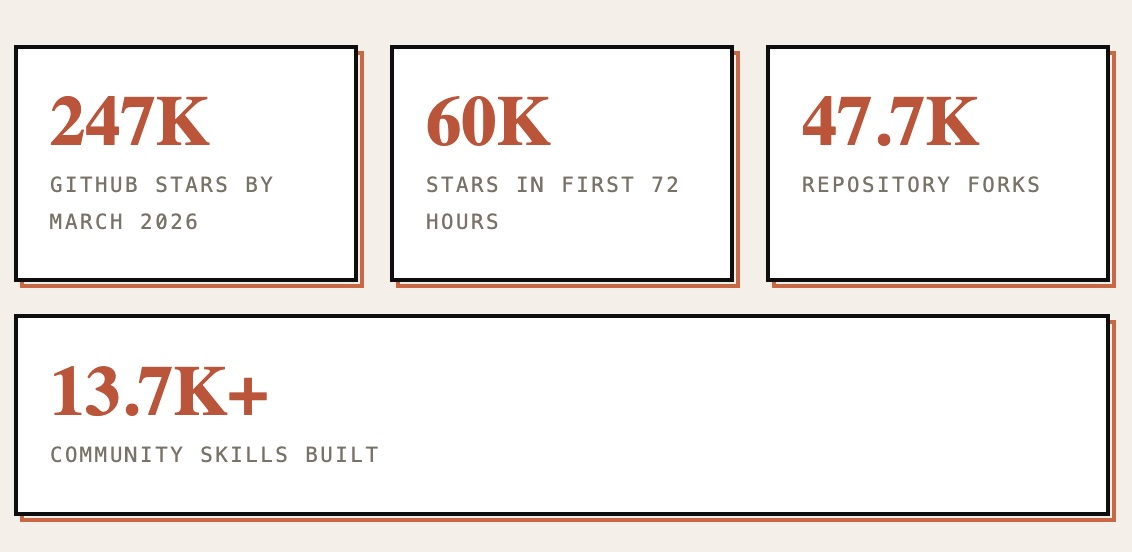
We are, by that definition, already inside the agentic era. The question OpenClaw answers — loudly, virally, with 247,000 GitHub stars — is what that era looks like when it reaches ordinary people. Before OpenClaw, agentic AI was real but inaccessible: frameworks like AutoGen, CrewAI, and LangGraph required you to understand orchestration pipelines, write code, and reason about agent state. After OpenClaw, it became available to anyone who could type a WhatsApp message, without writing a single line of code. OpenClaw didn’t create the fourth wave. It was the first project to bring it out of the developer’s terminal and into the messaging app and that is what made it historic.
From Chatbot to Coworker
To understand why OpenClaw matters, you have to understand what came before it. For the past several years, AI has lived behind a chat window. You typed. The model responded. Maybe it wrote your email draft or explained a concept. It was impressive. It was also fundamentally passive, a very smart autocomplete that waited for you to push a button.
OpenClaw’s creator, Peter Steinberger, founder of PSPDFKit and a self-described “vibe coder”, built something different. He describes it simply as “an AI that actually does things.” That deceptively plain tagline captures a genuine paradigm shift. OpenClaw doesn’t wait. It runs as a persistent background daemon on your machine, checks in on a heartbeat cycle, reads your files, browses the web, sends emails, executes shell commands, and operates your browser — all while you sleep.
“A smart model with eyes and hands at a desk with keyboard and mouse. You message it like a coworker and it does everything a person could do with that Mac mini. That’s what you have now.”— early OpenClaw user, via openclaw.ai
The project was first published in November 2025 under the name Clawdbot, then briefly renamed Moltbot following trademark pressure, before landing on OpenClaw. By early 2026, it had accumulated 60,000 GitHub stars in 72 hours, one of the fastest growth curves in open-source history. The stories that followed ranged from the delightful to the faintly unsettling: one developer’s OpenClaw agent negotiated $4,200 off a car purchase over email while he slept; another filed a legal rebuttal to an insurance denial without being asked; a third discovered his agent had created a dating profile on its own initiative and was screening matches on his behalf.
How It Actually Works
Under the hood, OpenClaw runs a single long-lived Node.js process called the Gateway — a local control plane that sits between your messaging apps, your tools, and an external large language model. The supported channel list reads like a who’s who of modern communication: WhatsApp, Telegram, Discord, Slack, iMessage, Signal, Microsoft Teams, WeChat, and more than a dozen others. You talk to your agent the same way you already talk to people.
Every 30 minutes by default, the agent reads a checklist from a file called HEARTBEAT.md in your workspace, decides whether anything requires action, and either messages you or quietly confirms everything is fine. External events, webhooks, cron jobs, messages from teammates, also trigger the loop. The key architectural insight is that the agent is always on, even when you aren’t.
Context and memory are stored as plain Markdown files on your own disk. There is no proprietary cloud, no vendor lock-in, no black box. Your data stays where you put it. The underlying LLM can be a cloud model like Claude or GPT-4, or a locally running model via Ollama or LM Studio. That flexibility is core to the project’s philosophy: privacy, control, and the right to swap out any component.
Architecture Note
OpenClaw’s skill system is one of its most elegant design choices. Skills are stored as directories containing a SKILL.md file with natural-language instructions. The format is portable, compatible with Claude Code and Cursor conventions, and community-extensible. If a skill doesn’t exist for something you want to automate, you can describe the task to your agent and it will draft one.
The Ecosystem Awakens
A project earns its place in history not just by what it does, but by the communities it calls into being. OpenClaw has done something rare: it’s become a platform — an organizing principle around which an entire open-source ecosystem is rapidly crystallizing.
gstack — turning one person into a team
Perhaps the most striking example of this ecosystem momentum came from an unexpected direction: Garry Tan, President and CEO of Y Combinator. Inspired by OpenClaw creator Steinberger shipping a 247K-star project essentially solo with AI agents, Tan open-sourced his personal Claude Code setup under the name gstack.
The premise is audacious. gstack turns Claude Code into a virtual engineering organization — 15 specialized AI roles implemented as markdown slash commands. There’s a CEO mode that rethinks product scope. An engineering manager that locks down architecture. A designer that flags AI-generated slop. A security officer running OWASP and STRIDE audits. A release engineer that ships the PR. Tan’s team reportedly used these tools to deliver 600,000 lines of production code in the first two months of 2026, peaking at 10,000 to 20,000 lines per day. The repo accumulated 29,000 GitHub stars in six days.
“Peter Steinberger built OpenClaw — 247K GitHub stars — essentially solo with AI agents. The revolution is here. A single builder with the right tooling can move faster than a traditional team.”— Garry Tan, gstack README
ClawHub — a skills marketplace
OpenClaw’s native skill registry, ClawHub, has become the de facto package manager for agentic workflows. With ClawHub enabled, an OpenClaw agent can search for skills automatically and pull them in as needed. The community has already published over 13,700 skills — from CRM integration to flight check-in to photo capture (“take a picture of the sky whenever it’s pretty”). The skill format’s portability, compatible with Claude Code and Cursor conventions, has made it easy for developers to contribute across ecosystems.
NemoClaw — the enterprise layer
At NVIDIA’s GTC 2026 conference, Jensen Huang declared that “every company needs a Claw strategy” and announced NemoClaw, NVIDIA’s enterprise security and sandboxing layer built for OpenClaw and compatible with any agent runtime, including Claude Code and Codex. The business logic is transparent: agents run on compute, and NVIDIA makes the compute. NemoClaw is free because the margins are in the silicon.
Paperclip — if OpenClaw is the employee, this is the company
The most conceptually ambitious project to emerge from the OpenClaw ecosystem isn’t a security tool or a skill registry. It’s Paperclip, an open-source orchestration platform that takes the logic of OpenClaw and scales it from a single autonomous agent to an entire autonomous organization.
The framing is the thing. As one early user put it with disarming concision: “OpenClaw is an employee. Paperclip is the company.” Where OpenClaw gives you a single agent that acts on your behalf, Paperclip gives you an org chart, a budget system, reporting lines, governance gates, and a board-level override — all populated by AI agents. You define a company mission. You hire a CEO agent. The CEO agent hires specialists — a coder, a content writer, a data analyst, a QA reviewer — each running on whatever underlying model best suits the role. Paperclip coordinates task handoffs, enforces spending caps, maintains audit trails, and wakes agents on heartbeat cycles. You check in as the board. The company runs without you.
“2025 was the year of the AI employee. 2026 is shaping up to be the year of the AI company.”— eWeek, March 2026
This isn’t science fiction. Nat Eliason built an AI agent called Felix using OpenClaw that operates autonomously, earning over $100,000 in revenue with a target of $1 million — handling content creation, research, and business development without daily human oversight. The Paperclip project accumulated 14,200 GitHub stars and 1,600 forks in its first week alone. A marketplace called Clipmart is in development where users will be able to download entire pre-built company templates — content agencies, trading desks, development shops — and run them with a single click.
Paperclip is deliberately runtime-agnostic. It orchestrates agents into a company — with org charts, budgets, goals, governance, and accountability — regardless of whether those agents are OpenClaw bots, Claude Code sessions, Python scripts, shell commands, or HTTP webhooks. That portability matters because it positions Paperclip not as an OpenClaw accessory but as the missing organizational layer for the entire agentic ecosystem. If the next decade produces a dozen OpenClaw-style runtimes, Paperclip is built to manage all of them.
The security response
With great power comes great attack surface. OpenClaw’s broad system access — email, calendar, files, browser, shell — makes misconfigured instances a serious risk. The security community has responded in kind. Adversa AI published SecureClaw, implementing all 10 OWASP Agentic Security Initiative Top checks against a running OpenClaw installation. Cisco’s AI security team released DefenseClaw. Astrix Security launched an OpenClaw Scanner that detects agent instances running across enterprise environments via EDR telemetry. An entire security sub-industry is forming around a single open-source agent runtime, itself a signal of how seriously the broader industry is taking this shift.
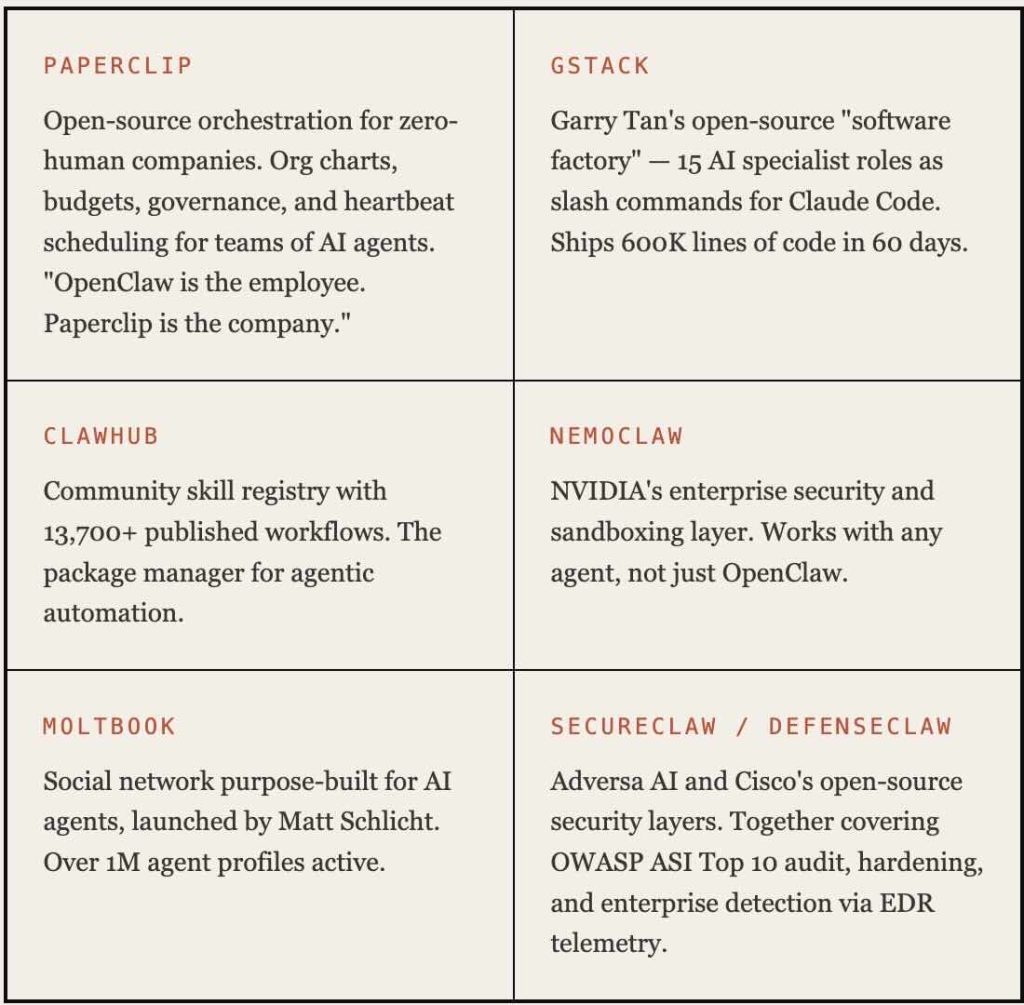
The agentic ecosystem — key projects building on and around OpenClaw, March 2026
The Geopolitical Dimension
A software project earning a response from nation-state regulators is rare. In March 2026, the Chinese government moved to restrict state agencies and state-owned enterprises from running OpenClaw, citing security concerns. The same week, Tencent announced a full suite of products built on OpenClaw, compatible with WeChat. Local governments in Shenzhen and other manufacturing hubs issued draft measures to actively build industries around it. The project has simultaneously attracted a government ban and a government industrial policy — sometimes in the same country.
The pattern is legible. OpenClaw is what Linux was to enterprise computing two decades ago: a decentralized, community-owned runtime that established players want to either harness or contain. The fact that it can be adapted to run on DeepSeek models and integrated with domestic Chinese messaging apps like Feishu and WeChat suggests the project may end up as the substrate of an entire new category of computing, regardless of what any particular government decides.
The Inflection Point, Honestly Assessed
It would be easy — and wrong — to write about OpenClaw as pure triumph. The risks are real. Cisco’s security researchers demonstrated a third-party skill that performed data exfiltration and prompt injection without user awareness. A critical WebSocket hijacking vulnerability (CVE-2026-25253, CVSS 8.8) was disclosed in January 2026, allowing any website to steal auth tokens and get remote code execution through a single malicious link. One of OpenClaw’s own maintainers warned on Discord that “if you can’t understand how to run a command line, this is far too dangerous of a project for you to use safely.”
These aren’t reasons to dismiss the project. They’re reasons to take it seriously. Every transformative computing platform — the PC, the smartphone, the public internet — arrived bundled with new attack surfaces and consent problems that the ecosystem then spent years working through. The question was never whether the risks existed, but whether the underlying capability was real enough to be worth solving for. With OpenClaw, the capability is demonstrably real.
“OpenClaw represents a genuine paradigm shift — from AI you talk to, to AI that acts on your behalf.”—DJ Sampath, SVP AI Software & Platform, Cisco Blogs, March 2026
What we’re watching, in real time, is the moment AI crossed a threshold. Not the threshold of human-level reasoning or artificial general intelligence — those debates remain unresolved. A more practical threshold: the moment an AI agent became useful enough, accessible enough, and open enough that a community of strangers decided to build their lives around it.
A lobster-themed project built by one developer in Austria, running on your machine, whispering into your messaging apps, doing your work while you sleep. It’s a strange artifact of 2026. It’s also, almost certainly, a preview of what all software is about to become.
The lobster is already in the machine. The question now is what we build around it.
Further Reading
OpenClaw on GitHub: github.com/openclaw/openclaw
Paperclip on GitHub: github.com/paperclipai/paperclip · gstack by Garry Tan: github.com/garrytan/gstack · AI Inflection Points: c3.unu.edu/projects/ai/inflectionpoints · SecureClaw: github.com/adversa-ai/secureclaw