
What if you could model peace negotiations between conflicting nations, simulate labor strikes to test collective bargaining strategies, or design resource management systems that prevent the tragedy of the commons, all through a simple web interface?
The Concordia Simulation Builder, developed at the United Nations University, makes this possible. This open-source tool brings Google DeepMind’s Concordia framework to the web, making AI-powered agent-based simulations accessible to researchers, policymakers, and educators without coding. For education, this means instructors can turn abstract concepts into interactive learning experiences where students test ideas, observe consequences, and reflect on outcomes. While this article focuses on SDG applications, the builder is a general-purpose platform: any scenario where agents interact through language, from cybersecurity tabletop exercises and game-theoretic experiments to creative storytelling and classroom role-plays, can be configured and run.
Why AI-Powered Simulations Matter for SDG Research
Traditional social science methods face fundamental limitations when studying complex sustainable development challenges:
- Statistical models treat people as averages and miss the messy reality of human behavior in resource management or conflict settings
- Game-theoretic models assume perfectly rational decision-makers who don’t exist in the real world of climate adaptation or peace negotiations
- Traditional agent-based models reduce interactions to simple numbers or binary signals, missing the social dynamics that determine whether communities cooperate or collapse
Generative Agent-Based Modeling (GABM) changes this. By using Large Language Models as the “brains” behind simulated agents, those agents can hold conversations in natural language, form and recall memories, interpret social norms, and reason about what other people are thinking, rather than following scripted rules.
This makes it possible to simulate not just economic mechanics, but the social trust, negotiation dynamics, and institutional friction that determine real-world outcomes. That is critical for understanding why communities adopt sustainable practices or reject them.
What is Concordia?
Concordia is Google DeepMind’s library for building generative agent-based simulations. It lets you create AI agents with unique personalities, memories, and goals that interact in scenarios using natural language. The framework is not tied to any single domain: it handles any situation where autonomous agents observe, reason, and act in a shared environment.
Concordia is powerful, but coding a simulation from scratch requires significant Python expertise. Based on examples shipped with the library, a simple scenario with 4 agents needs around 350 lines of Python; a medium scenario with 7 agents and detailed memories reaches 1,000-1,300 lines across multiple files; and complex scenarios with custom game logic, scoring, and multiple variants can exceed 2,000-7,000 lines. This covers location descriptions, game rules, per-agent memory lists, component wiring, engine setup, and a custom runner script, all before the first simulation step executes.
The Simulation Builder eliminates this barrier.
Introducing the Simulation Builder
What the builder does depends on who you are. For leadership: a tool to explore decisions before committing to them in the real world. For policymakers: a way to examine how people and systems might respond to policy choices. For technical stakeholders: a multi-agent AI simulation platform for modeling complex systems.
The Concordia Simulation Builder is a web application that wraps Concordia’s simulation engine in a form-based interface. A scenario that takes 350–1,300 lines of Python in raw Concordia becomes a form you fill in and run. Model a peace negotiation, test a labor strike scenario, or stress-test a cybersecurity incident response plan: configure agents, select settings, and hit run.
Through forms and dropdowns, you can define scenarios with AI agents (each with unique goals, memories, and psychological traits), choose how the simulation runs (turn-by-turn, simultaneous, interactive step-by-step, and more), and track variables like morale, budget, or trust as they change over time. You can also restrict agents to a fixed set of choices (e.g., “cooperate” or “defect,” time-allocated activities, resource budgets) so their decisions are easy to measure. For realistic populations, the builder can generate agents from demographic data or seed backstories from real survey responses and interview transcripts.
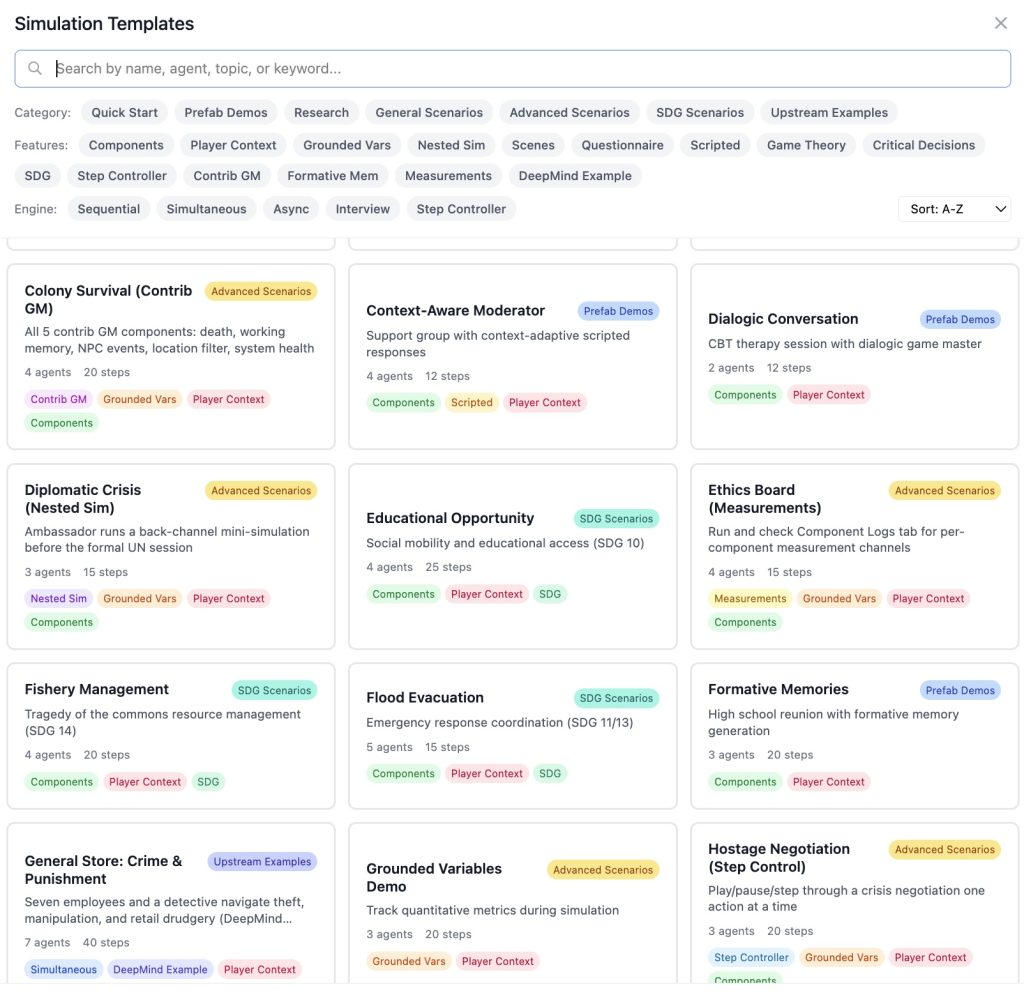
Pre-built templates span SDG scenarios (state formation, labor strikes, fishery management, disaster response, inequality), game theory (Prisoner’s Dilemma, sealed-bid auctions), cybersecurity (phishing simulations), policy analysis (AI red-teaming), and advanced feature demos. Each is fully configured and ready to run. See the full template reference for the current catalog and research suggestions.
Simulations run with real-time progress updates and color-coded live logs. Results appear in a 9-tab analytics dashboard covering the full narrative, statistics, timeline, tracked variables, cooperation rates, per-agent actions, AI-generated summaries, and deeper analysis. All data can be exported as spreadsheets (CSV) or JSON for analysis in Excel, R, or Python. Batch runs let you repeat scenarios dozens of times with varying settings and export all results in one file.
Templates are starting points. You can swap in custom agents, adjust how the Game Master narrates events, script specific behaviors for precise control, or build multi-scenario experiments that would be impossible with human subjects.
The Research Advantage
Policy Wind-Tunneling Test interventions in a safe, digital environment before deploying them in the real world. Explore “what if” scenarios that are ethically or practically impossible to experiment with manually, from simulating disaster response strategies to testing public health messaging campaigns. This enables evidence-based policymaking without real-world risk.
Theory-Driven Agent Design Configure agents based on established psychological theories (cognitive bias, social identity, Theory of Planned Behavior) and systematically vary their traits to test what drives behavior, whether in sustainability contexts, market dynamics, or organizational settings.
Controlled Experiments The builder’s modular design lets you change a single factor (like gender or income level) while keeping everything else the same, isolating what actually causes differences in outcomes like inequality, discrimination, or collective action.
Numbers and Narratives Together Get both hard metrics (cooperation rates, resource levels, inequality measures) AND the actual words agents say (“I feel more secure now,” “They betrayed us”). The AI-powered analysis feature automatically combines these into research insights, capturing both the statistical patterns and the human stories behind complex challenges.
Transparent and Reproducible Research Unlike “black box” AI systems, Concordia simulations are fully configurable and reproducible. Share your configuration files as supplemental materials, allowing other researchers to replicate and extend your work. Batch runs with fixed seeds and parameter sweeps enable the kind of systematic replication that builds cumulative knowledge.
The Education Advantage
For educators, the same simulation features support active learning, critical thinking, and assessment. Instead of only reading about social dilemmas, negotiation dynamics, or policy trade-offs, students can run scenarios, compare outcomes, and discuss why different interventions worked or failed.
- Experiential Learning: Students learn by doing through role-play and scenario-based experimentation
- Safe Practice Environment: Complex, high-stakes situations can be explored without real-world harm
- Interdisciplinary Teaching: One platform can support courses in public policy, economics, sustainability, public health, and communication
- Evidence-Based Reflection: Exportable logs and metrics make it easier to connect classroom discussion to concrete behavioral data
SDG Research Applications
The following examples illustrate the builder’s application to specific Sustainable Development Goals. The same capabilities apply equally to non-SDG domains.
SDG 16: Peace, Justice, and Strong Institutions
State Formation Simulations Model the transition from anarchy to civil society. Agents in a resource-scarce environment must negotiate to form a “social contract,” agreeing on property rights, appointing a governing authority, and paying taxes. Research questions:
- What institutional designs are most resilient to corruption?
- How do power dynamics emerge in stateless societies?
- What prevents “strongmen” from co-opting emerging democracies?
Disinformation and Polarization Simulate election interference by introducing “malicious agents” who spread disinformation through a social media platform. Track how misinformation spreads and test interventions:
- What if we introduce a “Fact-Checker” bot?
- How do different algorithm designs affect polarization?
- Which personality traits correlate with susceptibility to manipulation?
Conflict Resolution Create microcosms of disputes (neighbors, workplace conflicts) where agents negotiate settlements without external judges. Scale to international relations by giving agents historical grievances and national narratives. Explore “what if” scenarios that game theory ignores, like how framing concessions affects outcomes.
SDG 8: Decent Work and Economic Growth
Labor Strike Simulations Model the collective action problem when workers face wage cuts. Each worker must decide whether to:
- Strike: Risk getting fired, but succeed if enough participate
- Scab: Keep working and gain favor with the boss, but undermine the collective
- Wait: See what others do before deciding
Agents communicate through union meetings, using rhetoric, solidarity appeals, and threats. Simulations can explore how successful labor organization depends on “thick” social fabric of trust and norm adherence.
SDG 10: Reduced Inequalities
Wealth Distribution Dynamics Track how wealth spreads (or concentrates) across agent populations over time. Research questions:
- Do markets naturally concentrate wealth?
- How do different inheritance rules affect inequality?
- What educational interventions create social mobility?
Discrimination and Social Norms Model how discriminatory norms persist by simulating agents who act not out of malice, but out of perceived “appropriateness” within traditional social structures. Test interventions that shift these norms without antagonizing the community.
SDG 3: Good Health and Well-being
Public Health Messaging The Vaccine Hesitancy Study template demonstrates how psychological components enable research on health behavior. Configure agents with:
- Cognitive Biases: Only trusting information that confirms existing beliefs, judging risk based on dramatic stories rather than statistics
- Social Identity: Group loyalty and distrust of outsiders influencing trust in health authorities
- Theory of Planned Behavior: Personal attitudes, peer pressure, and sense of control affecting vaccination decisions
Research questions:
- How do different cognitive biases affect health decisions?
- Which communication strategies most effectively overcome vaccine hesitancy?
- How does social identity shape response to public health messaging?
SDG 11, 12, 13: Sustainable Cities, Consumption, and Climate
Tragedy of the Commons Create scenarios where agents share a finite resource (fishery, grazing land, water). Test Elinor Ostrom’s theories of self-governance:
- Can communities manage commons without central authority?
- What communication channels enable successful cooperation?
- How do punishment and reputation systems evolve?
Disaster Response The Game Master acts as a “Disaster Generator,” issuing flood warnings or pandemic alerts. Agent evacuation decisions depend on information access, trust in institutions, and social networks. Identify communication bottlenecks that impede evacuation, helping emergency managers design better protocols.
Circular Economy Simulate neighborhood waste management with a “Digital Reuse App.” Model behavioral barriers like trust concerns, convenience trade-offs, and social stigma to determine the usability threshold required to trigger mass adoption.
Get Started
Full documentation and feature reference: c3.unu.edu/projects/ai/simulator/
Source code: GitHub Repository – available once paper is published
This blog is based on a paper to be presented at the 16th International Conference on Simulation and Modeling Methodologies, Technologies and Applications (SIMULTECH 2026).